
India and China will resume direct flight services by the end of this month after a five-year gap, signaling an effort to rebuild ties strained by the border standoff in eastern Ladakh.

A high degree of mistrust continues to strain the bilateral relationship between India and China, the Pentagon has informed the United States Congress. New Delhi remains concerned by China's close military ties with Pakistan and its growing footprint in the Indian Ocean, Central Asia and Africa, Pentagon said in its annual report.
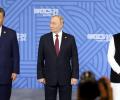
China has expressed its support for Russia's initiative to revive the Russia-India-China (RIC) troika, emphasizing its importance for regional and global security and stability.
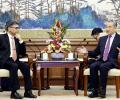
India and China have agreed to rebuild ties and resume people-to-people exchanges, including resuming direct flights and the Kailash Manasarovar Yatra this year. The two countries also discussed the resumption of dialogue mechanisms to address each other's concerns and move relations to a more stable path. The meeting comes after a period of strained relations following the Galwan Valley clashes in 2020.

The Indian and Chinese militaries held a fresh round of high-level military talks focusing on maintaining peace and security along the Line of Actual Control (LAC) in eastern Ladakh.

'Over the years, India has taken great strides in many fields, especially in the context of science and technology. Yet even as external disarmament is necessary, inner disarmament is no less important'

China and India should put their differences on the border issue at a "proper position" in bilateral relations and stick to the "right direction" of bilateral ties, Chinese Foreign Minister Wang Yi said on Friday.

The new title is likely inspired by the film's first track Maatrubhumi, sung by Arijit Singh.

Jaishankar said that both sides also exchanged views on the next steps in the India-China bilateral ties.

The Indian government has relaxed foreign direct investment (FDI) norms for countries sharing land borders with India, including China, a move that amends press note 3 of 2020.
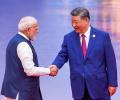
'When the Galwan incident took place, that was a big break in the trust factor between India and China.'

The meeting, which comes after the Doklam standoff, is aimed at a working a new paradigm for the bilateral relations for the next 15 years.

Following the BNP's victory in recent elections, Bangladesh is seeking to reset its relationship with India, emphasizing mutual benefit and a recognition of the changed political landscape.

Echoing United States President Donald Trump's stance on imposing economic sanctions against countries maintaining trade ties with Russia if Moscow doesn't put an end to the conflict in Ukraine, North Atlantic Treaty Organisaiton (NATO) Secretary General Mark Rutte on Tuesday (local time) urged India, China, and Brazil to reconsider their economic relations with Russia, warning of potential secondary sanctions, reported Reuters.

'Clearly, the warming of ties can be a 'win-win' for India and China,' says Ambassador M K Bhadrakumar.

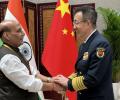
India and China have agreed to work towards a "roadmap" for rebuilding mutual trust following the border standoff in eastern Ladakh, according to a statement from the Indian Defence Ministry. Defence Minister Rajnath Singh met with his Chinese counterpart Dong Jun in Vientiane, Laos, on the sidelines of a regional security conclave. Singh called for drawing lessons from the "unfortunate border clashes" of 2020 and emphasized the need for cooperation rather than conflict. Both sides agreed to work towards a roadmap for rebuilding mutual trust and understanding, and a meeting of the Special Representatives and Secretary-Vice Minister mechanism will also take place soon.

Trump said that the decision would be "immediately" in effect and that the "order is final and conclusive."
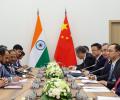
According to informed sources, Doval will arrive in Beijing on Tuesday to attend the crucial talks, which were expected to provide a way forward for the two countries to normalise the relations.
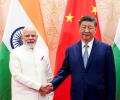
'What's currently underway is not a 'reset'.' 'What needs to be arrived at is a new balance.'

'No, India and China were not about to go to all-out war over a few rocks of Galwan.' 'The full picture of what went on at the highest level between two heads of State will not be known for a very, very long time and rightly so,' points out Colonel Anil A Athale, former head of the history division, ministry of defence.

But there is a bigger issue that both of us have brought forces close up and in that sense there is a militarisation of the border, he said.

The Bloomberg report suggests that this backchannel communication from President Xi has laid the groundwork for a broader thaw in relations. This overture has since translated into a series of tangible diplomatic actions leading up to the upcoming Shanghai Cooperation Organisation (SCO) summit.

JSW MG Motor India will launch four new models this year, and is planning to invest between 3,000 crore-4,000 crore in the country over the next couple of years. The new models include a plug-in hybrid, an electric vehicle, the Majestor SUV and one additional model yet to be disclosed.

Lavrov's comments came two days after Russia accused the US of attempting to prevent India and other countries from buying Russian oil, saying Washington was using a wide range of 'coercive' measures, including tariffs, sanctions and direct prohibitions.
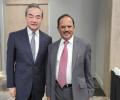
Doval is in Beijing for the 23rd round of the Special Representatives' talks being held after a gap of five years.
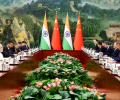
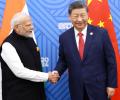
Chinese President Xi Jinping told Prime Minister Narendra Modi that India and China should approach their relations from a "strategic" and "long-term perspective" during their talks in Tianjin. Xi also emphasized upholding multilateralism and working towards a multipolar world.
India has cautioned against 'double standards' regarding its energy procurement from Russia, asserting that it is based on national interests and market dynamics, following a threat of secondary sanctions from NATO Secretary General Mark Rutte.

India and China on Monday decided to resume the Kailash Mansarovar Yatra as the two sides agreed to take certain people-centric steps to 'stabilise and rebuild' ties.
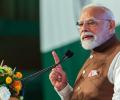
Prime Minister Narendra Modi on Friday said it is important for India and China to work together to bring stability to the world economic order as he asserted that New Delhi is ready to advance bilateral ties from a strategic and long-term perspective based on mutual respect, mutual interest and mutual sensitivity.
.jpg)
Prime Minister Narendra Modi in a conversation with Chinese journalists based in New Delhi on Tuesday said, "India and China are bound by history, connected by culture, and inspired by rich traditions. Together they can create a bright future for the entire mankind."

India and China reviewed the situation along the Line of Actual Control (LAC) in eastern Ladakh and prepared for the next Special Representatives' dialogue on the boundary question.
China has called Tibet-related issues a 'thorn' in India-China bilateral relations and a 'burden' for New Delhi, ahead of External Affairs Minister S Jaishankar's visit to China.

External Affairs Minister S Jaishankar said on Friday that India and China are going through a 'particularly bad patch' in their ties because Beijing has taken a set of actions in violation of agreements for which it still doesn't have a 'credible explanation' and it is for the Chinese leadership to answer where they want to take the bilateral relationship.
Former Army chief Gen M M Naravane (retd) said India-China ties are "on the mend" with initiatives announced at political, diplomatic and military levels. He expressed hope that China will reciprocate India's goodwill as they move forward in discussing the boundary question.
Chinese Foreign Minister Wang Yi said on Friday that India-China relations have made positive strides and achieved a series of encouraging outcomes at all levels after last year's breakthrough ending the over four-year-long military standoff in eastern Ladakh. Wang's remarks came during his annual press conference as he replied to a question on how Beijing views the course of bilateral ties after the two countries ended the prolonged stalemate in the ties.
Chinese President Xi Jinping on Wednesday pledged to strengthen the strategic relationships with neighbouring countries by 'appropriately' managing differences and enhancing supply chain ties as China's tariff war with the United States escalated.

United States Senator Lindsey Graham on Sunday claimed that Indian Ambassador to the US Vinay Mohan Kwatra spoke to him last month about India buying less Russian oil and asked him to tell President Donald Trump to relieve the 25 per cent tariff.
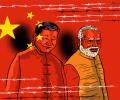
The bilateral trade between India and China has been growing at a healthy rate, but the trade gap remains sharply tilted in Beijing's favour. India has time and again flagged its concern over the ballooning trade deficit and the non-trade barriers faced by Indian goods in the Chinese market.
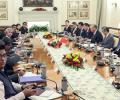
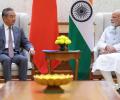
Chinese Foreign Minister Wang Yi's visit to India focuses on border talks with NSA Ajit Doval, amidst efforts to rebuild relations after the Galwan Valley clashes and rising India-US tensions.

India is preparing to resume the Kailash Mansarovar Yatra, a pilgrimage to Mount Kailash in Tibet, after a three-year hiatus. The decision comes as part of efforts to improve relations between India and China, which have been strained since a military standoff in 2020. The two countries have also agreed in principle to resume flight services between them.
